
CS 240 Spring 2026 AI Retrospective - September 25, 2026
Academic integrity and AI
Toward the end of the Spring 2026 semester, I found myself at the center of a storm involving use of "AI" in CS 240: Programming in C. My approach to addressing the issue should have been better and is primarily why the individuals that ran afoul of the clearly stated course policy ultimately incurred little to no consequence.
I am writing this post largely due to the number of students that continue to approach me and mention how much misinformation and inaccuracy surrounds the, apparently, ongoing discussions regarding the incident.
Policies and Expectations
To begin, I wish to be abundantly clear: the Spring 2026 offering of CS 240 had a clearly articulated prohibition with regard to using AI/LLMs to solve any assignments in the course. You can find it in the syllabus here. Specifically:
You may discuss assignments in a general way with other students, but
you may not consult anyone else's work. Among other ways to get an F,
you are guilty of academic dishonesty if:
...
- You utilize ChatGPT or other software to programmatically generate
solutions to any part of an assignment, quiz, or exam
Moreover, the syllabus clearly states that we may not immediately address violations of the academic integrity policy:
If we find reason to believe that a student or team has cheated on any assignment, we may inform the student or team promptly, or we may decide to silently accumulate evidence against the student or team on later assignments.
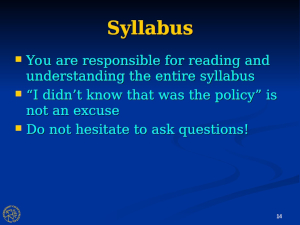
Finally, it was even clearly communicated in lecture that reading and understanding the syllabus was each student's responsibility, as mentioned on the slide from Lecture 1 found below:
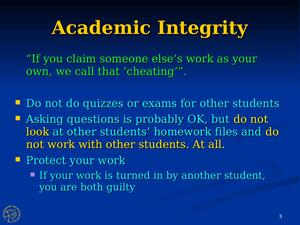
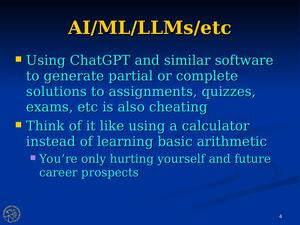
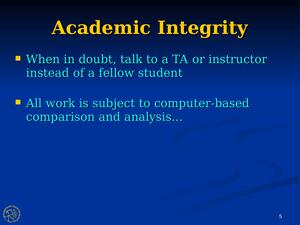
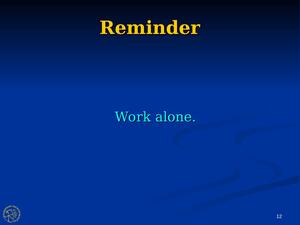
I have been told some people may be implying that the expectations above were somehow a surprise to those enrolled in the course. Such a claim is highly specious. In addition to the syllabus, I went back and checked: this expectation was addressed repeatedly in at least five lectures. I have included some of the slides from those lectures below. Note that while some may not explicitly mention AI, my slides are a starting point for what I discuss in lecture and do not encompass everything that is said. I will add that I am quite certain that I discussed these expectations at other times but without a slide to explicitly reference as well.
Here are the slides from Lecture 1 on January 12, 2026:
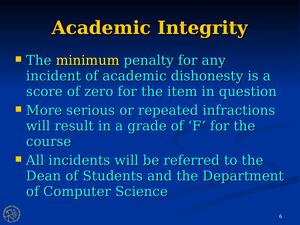
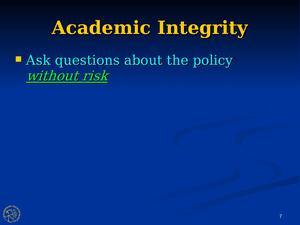
On January 14, 2026 I discussed the policy again in Lecture 2. While the slide itself does not mention LLMs, I did take the opportunity to mention the policy verbally again. Lecture 3 on January 21 included yet another reminder...
Another discussion occurred in Lecture 7 on February 4, 2026. It was at this time we were beginning to focus on specific identifiers during the development of Argus, the tool that would later be deployed.
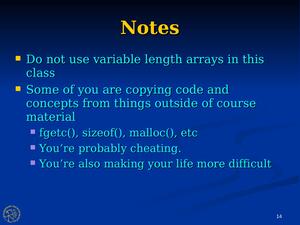
So, it was always the case that it was made abundantly clear to students that they should not be using AI/LLMs to complete assignments and that doing so was a violation of the course academic integrity policy.
Moreover, our usage of MOSS to identify cheating incidents proceeded as in semesters prior. Throughout the entire semester, students identified as having highly similar code were confronted and, when appropriate, incurred consequences resulting from their violation of the above policy.
Argus
Another mistaken impression some seem to have formed is that we trained our own LLM to assist with identifying students that violated this policy. We did not. The tool developed - named Argus - utilizes static analysis to identify indicators for which it is highly unlikely a reasonable explanation exists with regard to their presence in a student's source code.
Over the summer, we actually authored a paper regarding this tool. You can find a preprint version of it on arXiv or locally here. The paper was submitted to SIGCSE 2027. Though ultimately not selected for publication, the peer reviews from that process are available here.
As discussed in the paper, we have also run the tool against earlier semesters with very compelling and interesting results. In particular, the indicators that we use are virtually nonexistent prior to 2024 and their presence increases rapidly over the following years. All data gathered and analyzed point to high accuracy with regard to the H-score generated. I am certain many would like an exhaustive list of the indicators that we identify. But, providing such would almost certainly reduce the utility of the tool. If you are an educator or someone with a legitimate interest in this information, please feel free to contact me (jeff@cs.purdue.edu). I am unopposed to providing it in situations where I know it will be properly protected and used.It is important to point out that Argus served only as a starting point. Each potential case identified was looked at by at least one person prior to any further action. Not all cases were pursued. In fact, we took a very conservative look at each case, only pursuing ones for which there was clear evidence and a lack of any reasonable explanation for the existence of that evidence. Ultimately we flagged 267 out of 584 identified students (roughly 45.7%).
The Lead Up
Argus reached a usable state around mid-March of 2026. We began discussing it during our weekly TA meetings around that time, and on March 23 I ultimately decided to form an "AI Academic Integrity" (AIAI) team to address the large number of potential AI usage cases. We began efforts in earnest to set up the necessary processes.
Discussions continued after the formation of the AIAI team and, as we considered division of labor and preparation for meeting with hundreds of students, I was reminded of the approach historically taken by CS 159. In this course, instructors would email students identified as having violated course policy and offer them an opportunity to simply admit responsibility. One of these emails from Fall 2017 is included below. During our April 13, 2026 meeting I decided to adopt a similar approach utilizing a form that I would subsequently create with the hope that a self-reporting mechanism would cut down on the number of cases that would require further discussion.
Concerns of potential academic integrity violations have been raised
based on your submission for the fifth homework. The solution
you submitted has been measured and determined to be highly similar to
that of at least one other student in the course.
The work you submit must be your own original effort and not the result
of unacceptable, even if unintentional, collaboration. Although it may
not be intentional, extensive collaboration with others may result in
highly similar work that resembles copying. Every student is also
responsible for protecting his/her own work. If you inadvertently allow
your work to be accessed, you may still be held responsible for
facilitating an academic integrity violation.
Please take a moment to review the policies of the course found in your
syllabus related to academic integrity.
In this particular case, the high similarity between your assignment and
others was identified by computer software and upon review cannot be
dismissed by mere coincidence. As a result you will be assigned a score
of zero for the assignment according to the academic integrity policy
outlined in the course syllabus. If you are willing to accept these
findings, please reply to this email by the stated deadline (see below)
containing the following response:
"I acknowledge that my assignment submission is in violation of the
academic integrity policy of the course and accept the score of zero
for this assignment. I have no intentions of doing this again in the
future and realize that a second offense would result in my failing
the class."
After the above statement, you must include a short summary of the
actions and names of others involved that resulted in this incident.
There would then be no further repercussions as a result of this
incident and a favorable report will be sent to the Office of the Dean
of Students stating that you were cooperative and accepting of the
outcome. The case would then be closed as far as this class is
concerned, but the Dean of Students reserves the right to discuss this
incident with you in the future and take additional disciplinary action
if warranted.
If you wish to contest these findings, you must meet with me during
office hours on or before Tuesday November 14. Please be aware that
denial of the incident and/or fabrication of the events would result in
a less favorable summary to the Office of the Dean of Students if you
are found to be in violation, and additional penalties could then be
applied. Failing to respond to this request will be reported to the
Office of the Dean of Students as being non-cooperative.
I hope that this matter can be resolved as pleasantly as possible for
all involved. Thank you for your time and prompt attention to this matter.
Based on this email (and my use of similar ones in past offerings of CS 240 as well), I created the form found below. I will also note that this is where my use of the favorable/unfavorable language originated. Although some students also seemed at the time to be hung up on the possibility of suspension or expulsion, that is not something within an instructor's power nor is it something that typically happens for a first time offense. I did not mention either possibility in my communications or on the form, though I believe I briefly mentioned them in lecture as something the Dean of Students could consider.
The Process
On April 16, 2026, I sent out the following email with the subject "[CS 240] Academic Integrity Violation - RESPONSE REQUIRED":
Through careful analysis and manual review, we have identified what we
consider to be clear and concrete indicators in one or more of your
homework assignment solutions that it was partially or entirely
generated by an AI/LLM tool like ChatGPT, Claude, Copilot, etc. This is
a violation of the course academic integrity policy stated in the
course syllabus and reviewed during the first week of classes.
You are required to complete the form located at:
https://endor.cs.purdue.edu/~cs240ai/index.php
on or before Monday, April 20 at 5:00pm EDT.
Failure to respond will result in a grade of 'F' for the course. Note
that even if you intend to drop the course, we require a response.
Failure to respond will also result in an unfavorable letter being sent
to the Dean of Students along with further potential disciplinary
action.
Prof. Turkstra
--
Dr. Jeffrey A. Turkstra
Teaching Associate Professor
Department of Computer Science
Purdue University
Hall of DS and AI Room 1139E
475 Stadium Mall Drive
West Lafayette, IN 47907
(765) 496-3088
jeff@cs.purdue.edu
https://turkeyland.net/
A screenshot of the linked form is included below:
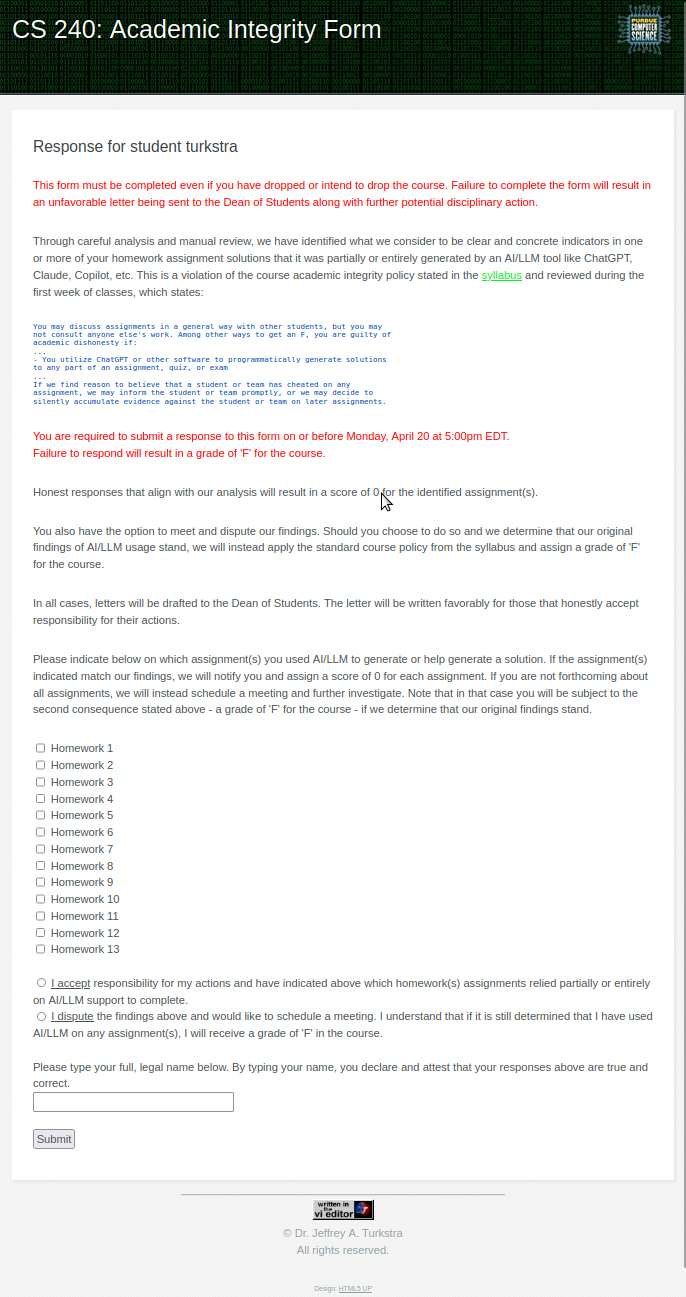
CS 240 had a beginning enrollment of 599 students for the Spring 2026 semester. At the time that the email was sent out, 65 students had withdrawn from the course already. The email above was sent to 207 enrolled students in the course. An almost identical email was sent to 60 additional students that had already dropped the course, since letters would still need to be drafted to the Dean of Students. This represents a little under 45% of the students.
It is worth noting that the standard penalty outlined in the syllabus for an academic integrity violation is stated below:
Academic dishonesty is a serious offense which may result in suspension or expulsion from the University. In addition to any other action taken, such as suspension or expulsion, a grade of F will normally be recorded on the transcripts of students found responsible for acts of academic dishonesty.
"grade of F" is bolded in the syllabus. For first time, minor violations on a single assignment, I typically proceed with the lesser penalty of a score of 0 and a course letter grade deduction.
As one can see from the form above, I lessened the penalty further in this situation partly due to the late deployment of the tool. The consequence would simply have been a 0 for each assignment.
The initial response to this process from my end was surprisingly positive. Before the university intervened, 117 students submitted the form. 108 simply took responsibility for their actions. Only 9 disputed the findings. It is an open question whether this is reflective of their actual behavior or instead something that underscores the purported, and unintentional, potentially coercive nature of the form. Ultimately, 144 students submitted enrollment drop requests for the course after this process began.
I met with well over a dozen students the following day. Every single one of them was apologetic. A handful of them even thanked me, sharing with me that they did not truly understand the ramifications of their actions until I had pursued these cases.
The Backlash
Simultaneously and without my knowledge, contact was being made by people - some invariably parents and students - both with our department head as well as the Dean of Students and other units on campus. I am also told there was significant discussion on the Purdue subreddit, though I have yet to subject myself to a gossip mill of such scale.
Eventually some of this stuff made it to me - including direct emails from individuals. Many of the ones that I saw were anonymous, which leaves one wondering whether they even originated from anyone associated with Purdue. Some were angry, some were abusive, but most, surprisingly, offered praise and support.
Of course this was only the beginning. I soon learned that the local newspaper - the Journal and Courier - had picked up the story. Soon after I was contacted by the Purdue Exponent, our campus newspaper as well. It was a chaotic time, and I was instructed to not speak to the press. So, I refrained from doing so initially. I did ultimately speak to a reporter with the Purdue Exponent after it became apparent that there were already recordings and transcripts of the relevant lectures floating around. You can read their article here. To be fully transparent, I will mention that I am on the board of directors for the Purdue Student Publishing Foundation, which publishes The Exponent. This affiliation did not influence the interview or article.
Discussions and Concerns
Meanwhile, things had reached a threshold where our Dean, Dr. Lucy Flesch, had become involved. I met with both her and our Department Head, Dr. Drineas, multiple times over the weekend of 4/18, engaging in fairly involved discussions. Ultimately these distilled down to two primary concerns: that some students may have felt coerced by the timing and format of the form. And, that there could be difficulty ensuring due process given the semester's rapidly approaching end.
Another concern discussed included the fact that the late deployment of Argus removed the opportunity for students to experience lesser consequences resulting from an initial violation and subsequently adjust their behavior. I was less sympathetic to this one, largely due to the clearly articulated course policies combined with the already lesser penalty mentioned above of a 0 for each involved assignment without even a course letter grade deduction or enforcement of the syllabus' stated grade of F.
The due process issue was somewhat less concerning to me as well. Partly because the existing university appeals process was already in place should the resolution at the course level be unsatisfactory. Partly because the students clearly had a mechanism to appeal directly to me before even beginning the sanctioned, university process. Not to mention there have been instances in Purdue's past where academic integrity issues were addressed after the conclusion of a course offering.
The concern that resonated with me the most was the possibility of innocent students feeling coerced. That was never my intention. The timing was, in fact, deliberate, but only because I rushed to get the information out before the university course drop deadline with the goal in mind of keeping that option available for students whose grades would be severely impacted by their actions. In other words, I was trying to give those that would fail a more graceful exit from the course.
In hindsight, I can see how that created a sense of pressure for some - particularly students that may have been incorrectly identified. Having spoken to trusted colleagues, I also see how the format of the form itself could be problematic. Specifically the requirement that they self report on which assignments they used an LLM instead of simply listing the ones that we had identified.
We discussed a number of ways to address the concerns. Ultimately, the decision that was reached was to reverse the retroactive use of the tool on earlier homework submissions. The tool would be used going forward, but any prior incidents identified by Argus would be ignored. Students that had dropped the course would be permitted to re-enroll.
This decision weighed on me, and I actually reached back out on Sunday expressing my concern with the resolution. I suggested again an alternate approach of allowing students to resubmit identified homework assignments, acknowledging that it may have required the assigning a grade of incomplete and resulted in additional work for me over the summer.
We met one final time on Monday morning prior to my first lecture at 9:30am. After further discussion, we settled on sticking to the original resolution.
The Resolution
While all of the above was happening, it was also becoming abundantly clear that a group of people were continuing to stir things up online. I was warned that many individuals not enrolled in the course were intending to show up to the lectures that day in the Class of 50 Lecture Hall. To mitigate this concern, I asked for volunteers from our TAs to ensure that entry was only granted to students enrolled in the course. We also requested that a fire marshal be present to ensure we remained within the capacity constraints for the facility.
I am grateful to the Purdue Fire Department for their presence in the hall during that time. The TAs, as well, did an outstanding job in keeping a chaotic situation under control. They have my sincere gratitude as well.
I want to be clear that our efforts were made solely to ensure people's safety as well as preserve the classroom environment for enrolled students. No attempts were made to control the release of information. In fact, at one point one of the TAs brought to my attention that a student was streaming a recording of the lecture to others outside of the room and asked if they should be told to stop. I unequivocally indicated that it was fine for them to do so in that specific situation.
I started the lecture discussion with the slide below:
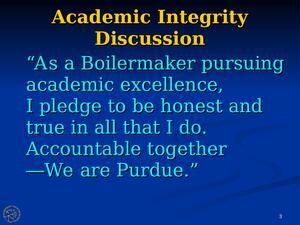
This is the Purdue Honor Code. Each student agrees to adhere to it when they start here at Purdue University.
I spent a substantial amount of course time discussing course policy, the existing MOSS process (which was not impacted), the concerns outlined above, and the ultimate resolution. I also emphasized that I lack the ability to suspend or expel a student and that the Dean of Students typically considers that only when there are prior offenses or egregious behavior like deliberate misrepresentation or lying.
I restated that our goal and approach here was to only consider students that had blatant anomalies for which the only reasonable explanation we could come up with is the usage of an LLM. I even mentioned the well known Benjamin Franklin quote - "it is better 100 guilty Persons should escape than that one innocent Person should suffer." I share this belief and used it to guide our actions throughout the process.
Ultimately, as I mentioned above, we decided to discard the retroactive findings. We did use the tool moving forward for the remaining assignments. Of the 144 students that dropped initially, roughly half (74 students) re-enrolled in the course.
I will mention that I also displayed these two, ad hoc slides generated by one of our head TAs, Ajay Rawat, and discussed the clear difference in performance on both midterm exams for those identified as using an LLM.
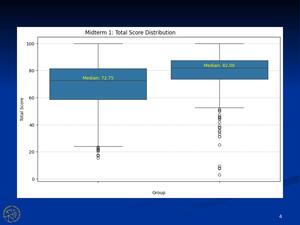
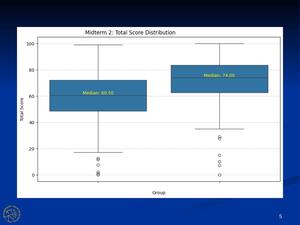
For the first midterm exam, the difference was 10.75%. On the second midterm, it was even greater: 14.5%. Better graphs and a more thorough analysis can be found in the Argus paper. There is very strong and compelling evidence across multiple semesters that students that use LLMs while learning to program perform significantly worse on controlled assessments. There are an increasing number of compelling studies like this out there, including the well-known MIT Paper. This is, perhaps unsurprisingly, not limited to programming.
Takeaways
The way in which I addressed these cases should have been better. Primarily, the process that was put in place should have clearly articulated the identified assignments and probably involved meeting with each student individually. Though, again, there is precedent for the meeting being student initiated.
The timing was also unfortunate. Certainly the safest approach would be to ensure deployment of a tool like this only at the beginning of the semester. If that is not possible, retroactively applying it to earlier assignments is something that should be carefully evaluated and only pursued with knowledge and support of other relevant university units.
Regardless, deploying close to the drop deadline is certainly unwise.
If you are one of the innocent students that experienced undue stress because of the pressure created here, I offer you my sincere apology. I am sorry.
I do remain convinced that the vast majority of students identified here cheated. Not because the tool identified them, but because we actually looked at the markers and associated code.
If you are reading this and are one of those students, you have behaved in a way contrary to the Purdue spirit and our Boilermaker values. Moreover, you took an Honor Pledge upon joining the student body at this university, and your actions have clearly violated that pledge.
That said, I have no judgment to pass on you here. We are all human beings, we all make poor choices and mistakes in our lives. I genuinely hope that you learn from this and alter your course, making better decisions in the future. If for no other reason than doing so will make you a better person and a better computer scientist.
The quote from my lecture that the Purdue Exponent ended with in their article is a poignant one: "We have students who have invested a lot of effort, have not cheated, and now get to watch some of your classmates leave with no consequences," Turkstra said. "I don't have an answer to that." Perhaps my biggest regret here is very much that.
I do take solace in a few things, though. First, the data both in our ad-hoc analysis at the time as well as our subsequent paper show clearly that students who cheated have worse grades. Second, while the percentage of students identified was substantial, it was still less than 50%. Most students are engaging in a good-faith effort to learn the material. And, third, this entire situation has, I think and hope, helped our students better understand the detriments of taking shortcuts in learning.
Another takeaway, for me, is the recognition that this process and resolution was made under pressure. In hindsight, I should have worked harder to address the PR concerns on the university's side while ensuring the resolution itself was measured and unhurried.
Argus was deployed for the remainder of the Spring 2026 semester and has been in use in subsequent offerings of CS 240.